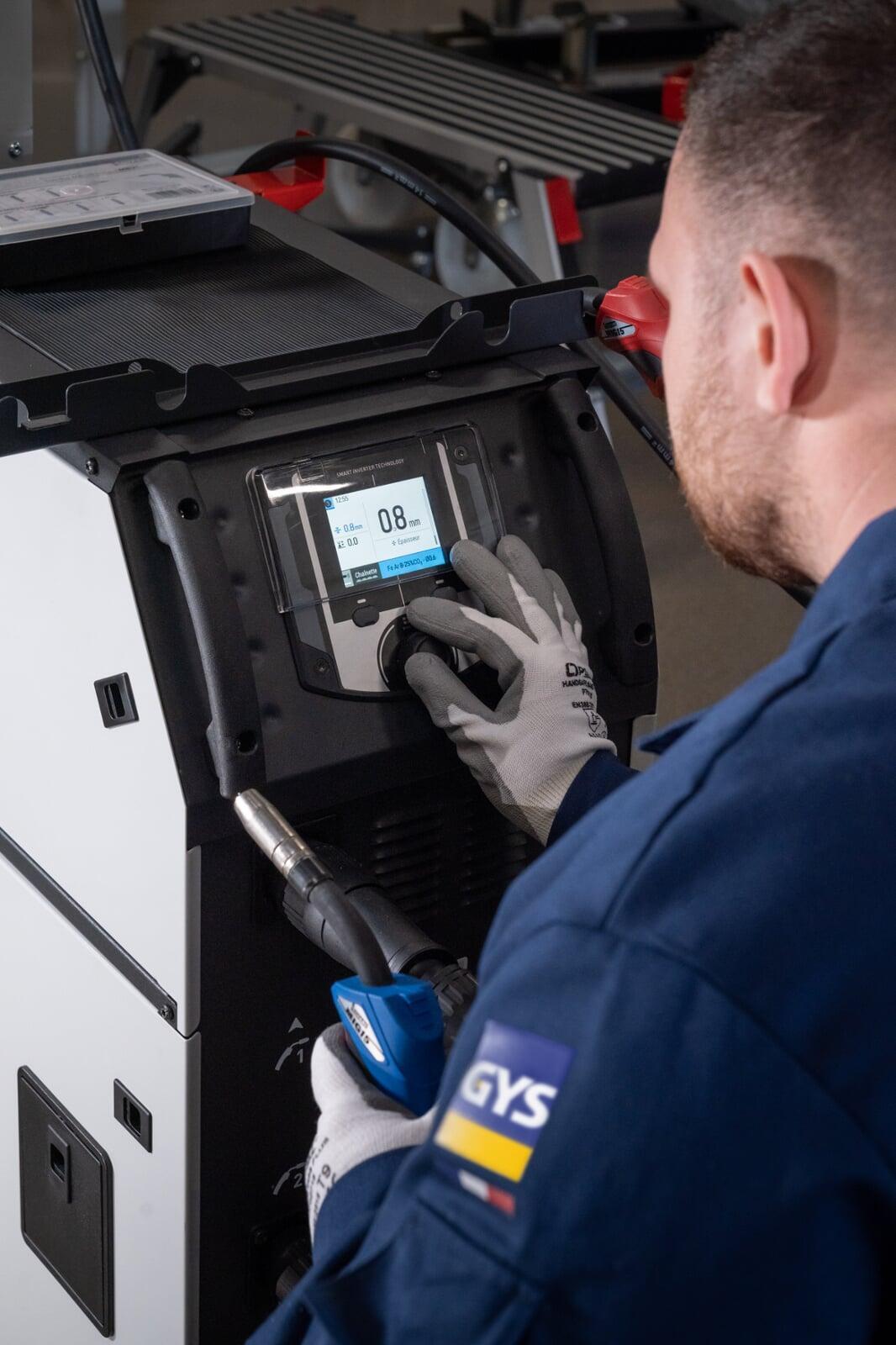
Buy the machine this year.
Deduct all of it this year.
The July 2025 tax law made 100% first-year write-offs permanent and lifted the Section 179 ceiling to $2,560,000 for 2026. A spot welder, a pulse MIG, a lift, a scan tool — the whole purchase can come off this year's income instead of being spread across five.
What will it really cost?
Enter a price and your tax rate. The same arithmetic your accountant starts with.
Illustration, not tax advice. We sell equipment, not accounting. Your entity, income, state and timing all move this — take it to your CPA. Section 179 cannot exceed your taxable business income and cannot create a loss; bonus depreciation has no income cap, which is why the two are used together. State conformity varies and several states do not simply mirror the federal rules.
Three figures decide the size of it.
$2,560,000
Expensed in full, in year one. Up from $2,500,000 in 2025.
$4,090,000
Of total §179 property placed in service. No independent shop is near this.
100%
Permanent for qualified property acquired after January 19, 2025. The phase-down is dead.
$32,000
The most of a sport utility vehicle's cost you can take under §179 for 2026. Vehicles have their own rulebook.
The deduction follows the calendar, not the invoice.
Qualifying property has to be placed in service by December 31 to count for this tax year — installed, powered and available to do work, not ordered or paid for. Here is the run-in.
Order against a 10–14 week factory lead time in late November and the deduction lands in 2027. Equipment already on a floor in the United States is what makes the date achievable this late.
You have committed to buy it.
A signed order, a binding contract, a deposit. The easy gate — and the one most people think is the whole test. A purchase order dated December 28 does not do it on its own, and neither does a wire that clears on the 30th.
It is in your shop, installed, and ready to work.
Delivered, wired to the right voltage, coolant in it, arms on it, available for use in your business on or before December 31. The electrical is the step that slips most often — book the electrician the day you order, not the day the crate lands.
Three provisions. One effect.
These are the code sections your accountant will name. Worth knowing them before the conversation, so you are not nodding along.
Expense it instead of depreciating it.
Lets you elect to treat the cost of qualifying equipment and off-the-shelf software as an expense rather than a capital asset you write off slowly. The 2026 ceiling is $2,560,000, reduced dollar for dollar once you place more than $4,090,000 of such property in service.
The limit that actually bites: §179 cannot exceed your taxable business income. It cannot create a loss. Anything over the line carries forward.
The phase-down was reversed.
The scheduled drop to 40% is gone. Qualified property acquired and placed in service after January 19, 2025 gets the full 100% special depreciation allowance, and it is permanent now rather than sunsetting.
The difference that matters: unlike §179, bonus depreciation is not capped by business income — it can push you into a loss. Which is exactly why the two get applied in a specific order.
Financing costs less after tax.
The cap on deducting business interest went back to an EBITDA basis instead of EBIT. In plain English: depreciation no longer eats into the interest you are allowed to write off.
And most shops are exempt anyway: if your average annual gross receipts over the prior three years are under $32,000,000 for 2026, the interest limitation does not apply to you at all.
What qualifies in a collision shop — and what quietly does not.
Broader than most owners assume on the left; narrower than most hope on the right. Your CPA makes the final call on every line.
- Welding equipment
- Resistance spot welders, MIG and pulse MIG, rivet and SPR guns, plasma cutters.
- Dent pulling & induction
- Pullers, studders, induction heaters, glue-pull systems.
- Lifts & frame
- Two-post and scissor lifts, benches, frame racks, measuring, anchoring.
- Diagnostics & ADAS
- Scan tools, calibration frames and targets, alignment.
- Paint & refinish
- Prep stations, curing lamps, mixing equipment.
- Shop infrastructure
- Compressors, extraction, A/C service machines, battery charging.
- Off-the-shelf software
- Shop management, estimating, purchased licences.
- Used & refurbished equipment
- §179 has always allowed it, and bonus depreciation does too — as long as it is new to you.
- Improvements to the building you work in
- HVAC, roofs and qualified interior improvements to non-residential property.
- The building and the land itself
- The structure is not §179 property. Specific improvements to it can be.
- Inventory and parts you resell
- That is cost of goods — a different deduction entirely.
- Anything bought from a related party
- A machine from your brother's shop, or from your own second entity, can be disqualified.
- Mixed personal use
- Only the business-use share counts, and dropping below 50% triggers recapture.
- Vehicles
- Their own rulebook. SUVs are capped at $32,000 under §179 for 2026, and a dedicated service truck is a different conversation than a family SUV with a shop logo on the door.
- Property used outside the United States
- Generally excluded.
- Selling or scrapping it early
- Recapture — the one that surprises people two years later.
§179 and bonus depreciation are not a choice. They are a sequence.
A common misconception is that you pick one. In practice your accountant applies them in order, and the order changes the answer.
§179 goes first, selectively.
Applied asset by asset, up to the ceiling, capped at taxable business income. Because it is elective per asset, it usually gets pointed at the property with the longest recovery period — the stuff that would otherwise take the most years to write off.
Bonus depreciation sweeps the rest.
100% of whatever basis is left on qualified property. No income cap, so this is the piece that can create or deepen a loss — sometimes deliberately, sometimes to be avoided. It applies automatically unless you elect out.
Regular depreciation cleans up.
Anything not expensed depreciates normally under MACRS over its class life. Most collision shop equipment lands in the 5- or 7-year class.
Writing off 100% in year one means there is no depreciation left for the next five. If you expect a much better year — or a higher bracket — in 2028 than in 2026, that deduction is worth more later than it is now. A good accountant will sometimes tell you to take less than you are entitled to, and they will be right. Have that conversation before you sign, not after.
Financing, leasing, and the machine you are replacing.
Financing does not reduce the deduction.
The write-off follows the cost of the asset you placed in service, not how much of the note you have paid down. A machine bought in December on 60-month terms is generally deductible on the same basis as one paid for in cash — small cash outlay, full-year deduction.
Leases are where it gets specific. A capital or finance lease with a nominal buyout is typically treated as a purchase and qualifies. A true operating lease usually does not — you deduct the payments as rent instead, which is a real deduction, just a different one. The lease document decides this, not the salesperson. Put it in front of your CPA before you sign. Your GYS dealer can structure it either way and show you both alongside the cash number.
A trade is really two events.
Since the 2017 tax act, like-kind exchange treatment applies only to real property. Equipment trade-ins are no longer tax-deferred. You sold the old machine and you bought a new one. If the old unit was already fully depreciated, the trade value can come back as ordinary income through depreciation recapture — even though no cash changed hands and it felt like a discount.
That is not a reason to avoid a trade. It is a reason to know the number before you agree to it. Get the trade figure in writing so your accountant can work with a real number instead of a headline.
Two machines that can realistically clear the deadline.
Both built by GYS. Both stocked in the United States — which is the only reason the date is achievable this late in the year.
GYSPOT PTI Genius Plus
Squeeze-type resistance spot welder. The machine that satisfies OEM procedures on high-strength steel and boron — and the one an insurer's auditor asks about by name.
- Weld current
- Up to 14,500 A
- Clamp force
- 600 daN — UHSS and boron
- Gun
- 27.3 lb, 360° gyroscopic, 3" pneumatic over-opening
- Boom
- 55" motorized reach, takes cable weight off the tech
- Speed
- Around 15 spots per minute
- Control
- 7" colour touchscreen — Auto, Synergic, OEM, Manual
- Traceability
- USB weld-data export for the file
- Power
- 208 / 240 V — also 480 V as ref. 082267
Configured to your shop — arms, caps, coolant, plug. Whatever the final number, 100% of it comes off 2026 income if it is running by December 31.
GYS AUTO P3
220 A single-phase pulse MIG/MAG with three wire feeders — steel, silicon bronze and aluminium live on the machine at once. No spool swap between processes.
- Output
- 220 A single-phase pulse inverter
- Feeders
- Three — no spool changes mid-job
- Torches
- Steel, CuSi and aluminium included
- Setup
- Synergic — short training curve, fewer errors
- Memory
- 200 jobs, USB software updates
- Cart
- 161 lb, dual gas cylinder support, wheeled
- Power
- 208 / 240 V single phase, PFC 185–265 V
- Consumables
- Abicor Binzel style — stocked in the US
The way into pulse for a shop that is not ready to commit to a spot welder — and 100% deductible in 2026 on exactly the same rules.
Pricing comes from your dealer, not from a web page — configuration, arms, torches and install all move it. Financing is available; ask your dealer when you get the quote.
Questions we actually get asked.
General information about how these rules work — not advice about your return.
Does the equipment have to be new?
No. Section 179 has always covered used equipment, and since 2018 bonus depreciation does too. The test is that it is new to you — you cannot have used it before, and you generally cannot buy it from a related party. A properly reconditioned machine can be a very efficient way to use the deduction.
What if my shop does not have much taxable income this year?
Then §179 is limited. It cannot exceed your taxable business income and it cannot create a loss — the excess carries forward to a future year instead. Bonus depreciation works differently: no income cap, and it can create a loss. That is the main reason the two provisions get stacked in a particular order, and it is a decision for your accountant, not a rule of thumb.
If I finance it, do I still get the full deduction?
Generally yes. The deduction follows the cost of the asset placed in service, not the amount you have paid down. That is why financing in Q4 is so common: a modest cash outlay in December against the full deduction for the whole year. And because the interest rules went back to an EBITDA basis — and shops under $32,000,000 in average gross receipts are exempt from the limitation entirely — the interest itself is usually deductible too.
What about a lease?
Depends entirely on the lease. A capital or finance lease with a nominal buyout is typically treated as a purchase and qualifies. A true operating lease generally does not — instead you deduct the payments as rent, which is still a deduction, just a different one with a different timing profile. The lease document decides. Send it to your CPA before you sign it, not after.
Can I write off a service truck or a shop vehicle?
Vehicles have their own rulebook, and it is stricter. For 2026 the amount of a sport utility vehicle's cost you can take under §179 is capped at $32,000. Weight rating, business-use percentage and vehicle type all change the answer, and a dedicated service body is a genuinely different case from a family SUV with a shop logo on the door. Worth a specific conversation.
Does software count?
Off-the-shelf computer software generally qualifies for §179. Custom-developed software and most cloud subscriptions are treated differently — a subscription is usually just a deductible operating expense in the year you pay it, which is simpler but not the same thing.
What happens if I sell the machine in two years?
Recapture. If you dispose of the equipment, or your business use of it drops below 50%, inside its recovery period, some of what you deducted comes back as ordinary income. This is the most common unpleasant surprise attached to Section 179 — do not expense something you already intend to flip, and factor it in before you trade a machine you wrote off two years ago.
Is there any reason not to deduct it all in year one?
Yes, and it is a real one. Take 100% now and there is no depreciation left for the following five years. If you expect a substantially better year, or a higher bracket, in 2028 than in 2026, that deduction is worth more later than it is today. A good accountant will occasionally tell you to elect less than you are entitled to. If yours does, listen — the goal is the lowest tax over years, not the biggest number on this year's return.
The short glossary.
One form. It comes to us, and we get it to the right hands.
Wherever your shop is, send it here. Tell us your ZIP and we will get the right person on it — local where there is local coverage, direct where there is not. You should not have to work out who covers your territory or find out three weeks later that you called the wrong branch.
You get a straight answer on stock and delivery, so you know before you commit whether December 31 is achievable. Installation, training and warranty service are arranged with the machine, not sold to you later. Consumables and wear parts are on a shelf in the US, not on a boat.
Ask a tech, not a salesperson.
A GYS-trained technician will tell you what the machine does, what it needs, and whether the calendar still works — within one business day.
Informational only and not tax advice. Deduction limits, income caps and state conformity vary by taxpayer and by state; several states do not simply mirror federal treatment. Confirm your situation with your CPA or tax advisor before relying on anything on this page. Figures for the 2026 tax year: IRS Rev. Proc. 2025-32; P.L. 119-21; IRS Publication 946.